Category: Literature Analysis
Showing posts with label Literature Analysis. Show all posts

Freytag will only take you so far...

Thursday, May 14, 2015 2 comments
Tried and Tested by Lori

Because I am a teacher, I own a certain level of nerdery that cannot be disputed and includes the following awkward notions.
  • An inherent love of school supplies. This one is fun because...um...school supplies.
  • An irritating capacity for memorizing state standards and the various ways it has been tested throughout the years. This one is annoying, and here's why.
There is a certain standard that is responsible for uglying up all kinds of data in my current district. Allow me to share with you--straight from the 8th grade TEKS--my 2014-15 arch-nemesis from the reading strand, 8.6A:
  • Students are expected to analyze linear plot development (e.g., conflict, rising action, falling action, resolution, subplots) to determine whether and how conflicts are resolved.
This is Freytag. It will only take you so far (which is not very).
When many teachers look at this, they believe--understandably so--that if they teach with the good ol' Freytag model then students are getting the level of instruction required by the TEKS. Heck...look at this question from the 8th grade 2014 STAAR test.


Knowing how to plot out that story on the Freytag would absolutely answer that question. But take a look at the rest of the questions on that same test with the same coding (I'm telling you...nerdery all over the place).
___________________________________________________________________

___________________________________________________________________

These types of questions cannot be answered with the Freytag! What's a Curly girl to do?! I am loving my new approach with picture annotations! Let me show you how cool this is. First, students learn the fiction symbols from our GENRE BOOKMARKS, and here's how I teach it. 

Fiction is made up of:
Typically, the way a character interacts with his or her conflict indicates theme

For example, if a character is determined and confident and faces his problem head on, then perhaps we are learning the value of bravery. If a stubborn character experiences something that makes him or her reflective, then the themes about being open-minded and learning from experience begin to emerge.

But if kids aren't tracking this and making inferences as they read, the depth is lost on them. I believe we've done our children a disservice by teaching them that annotating means summarizing out to the side as you read. Curly friends, that's plot and we have to go deeper.

With this style of fiction annotations, students are trained to recognize and track three key elements of fiction and learn how those elements interact with one another to form a greater picture. 

The annotation examples below are from a re-test intervention that I've been teaching for the last two weeks. On our first day, I spent time asking students how they read and what they did while they read. Overwhelmingly, students told me that they had given up on annotating (summarizing as they go) because it never helped. After several days practicing our fiction annotations, I watched kids grow and learn to approach fiction with purpose and with a process to analyze linear plot development (e.g., conflict, rising action, falling action, resolution, sublots) to determine whether and how conflicts are resolved. (Again with the nerdery.)

Notice how the student has used her pictures to indicate the fiction element,
has underlined corresponding text, and has written a quick inference--not a summary.

I like how this student was simultaneously keeping track of the conflict
and the character's emotional response to it.

These picture annotations helped students see beyond the plot in an accessible and meaningful way. They left Freytag in the dust and are much better for it. 

A Three Ring...

Tuesday, May 12, 2015 2 comments
your ring leader, Suzanne

...non-circus!  Now we're talkin'!

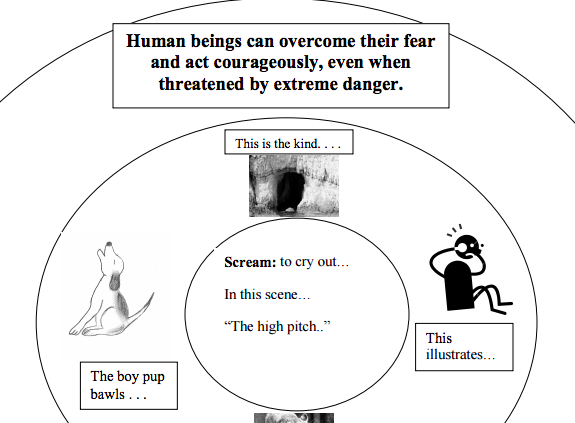
This is a reading strategy from Laying the Foundation that works well after reading a text.  
You can provide students with a handout of three concentric circles, orrrrrr students can draw them themselves.  A month of school left and an opportunity for low/no prep? Sign me up!

In the innermost circle:
-Write the most significant word from the assigned text
   Choose to include 2 of the following:
   -Provide a quote to support your choice of that word.
   -Explain in their own words how this word is important in the context of the story.
   -Provide the dictionary definition for the word.
In the middle circle:
-Draw four pictures/images inspired by the assigned text.
-Under each picture, explain how the image connects to your chosen word.
In the outermost circle:
-Write two thematic statements drawn from the significant word and images. Remind students that their theme statements are big about life- true in this story, and this movie I saw, and in my own life.

Students are easily engaged because every circle has different directions.  They also get hooked with the opportunity to draw.  This is a great way to get students thinking deeply about something they've read...no lion tamer needed!

Amuse-bouche

Thursday, March 5, 2015 No comments
Serving up a tiny taste, Lori

Instead of feeding them everything all at once,
give students a small--yet rich--bite
to chew on for a while.
I'm not at all a foodie, but I do watch just enough of the Food Network to be dangerous. Today's title is inspired by the French term for a tiny appetizer, usually served a single bite and just enough to give you a taste of what's to come. 

Last weekend I was fortunate enough to be able to attend the 2015 Abydos conference here in Dallas, and I walked away with tons of ideas. The one featured today comes to us from Rebecca Singley in Spring Branch ISD. Rebecca, a Silver-level trainer, presented her re-certification work based on the idea of what she refers to as "Rhetorical Chews." Her AP III students are used to this process which works to help them analyze devices or "tools" across all genres. Although geared toward AP III, my teacher brain was in over-drive thinking about how this strategy would work in on-level and maybe even remediation classes. 

Before we begin this main course, let me back up and tell you about a conversation that I had with some of my colleagues the other day. In my district, we place a heavy emphasis on active reading and annotating the text. However, students run into problems when the annotations are like a shot-gun blast. Anything and everything is supposed to be marked and considered. How are struggling students supposed to wade through the mass and make a single and focused connection? 

Thanks, Rebecca Singley! I think your strategy is just what we needed! Here's how it works:

1. Students are given an article and provided with a reading purpose. She gave us a copy of Leonard Pitts' article, "Social Media Can Be Deadly." We were told to read and answer the question: What is Pitts saying about the use of social media in today's society?

  • Instructionally, I would use this time for comprehension just to make sure kids get it. I would probably even break the text into manageable chunks and use a reading strategy like paragraph for paragraph or even paired reading

2. After reading, she gave us the literary device that we needed to focus on, and this is the process that we used. It spells TEETH, which is adorable. 

  • Tool--What is the device and its function in the piece?
  • Evidence--Provide at least one example from the text that contains the tool.
  • Effect--How does that support the author's purpose? What is its effect on the reader?
  • Thesis--Refer back to your thesis (the answer to the reading purpose). How does the use of this tool support the author's purpose overall?
  • Instructionally, I would have students fold their paper into quarters and work on these TEETH sections. In an on-level class, I definitely would structure it so that for the first day we are living with comprehension/identification. What is the device? What is its function, and where do you see it?
  • The following day, we could work on effect and its connection to our thesis (our opinion of what the author is doing).
3. After students have finished chewing with their TEETH, they can select portions of the TEETH and write a nice little paragraph (or even an SAQ).
*I will disclaim this by saying that STAAR SAQs do not ask for analysis of devices. However, multiple choice questions absolutely do.

This is a great way to do focused analysis of one device. It's a great way to build depth to the visual dictionary. And, most of all, it is a perfect model for my favorite thing ever--targeted and explicit instruction. 

Try this strategy and give your kids a taste of some genuine and in-depth analysis!

A very special thanks goes out to Rebecca Singley from Spring Branch ISD. Thank you for your commitment to your students, to the process, and to the professional development of your colleagues. 


Foldin', Foldin', Foldin'...

Monday, August 4, 2014 2 comments
Folded by Lori

Take one look at my house and you know I'm not talking about laundry! 


Welcome to our latest series featuring our favorite foldables! We often joke that the crux of our instruction rests on colored paper and origami, but there is a little bit of truth to that. Foldables are engaging and student-centered because you can help students organize their thinking without a worksheet or a handout. Typically, once kids have made something, they have more ownership of it. 

Our first foldable fave involves just three simple folds, and can be used in at least 3 different ways. But really, the possibilities are endless!

The Four Corners Foldable 

  • Fold your paper, short edge to short edge (hamburger).
  • Keep that fold, and then fold the long edges together (hotdog).
  • You should have 4 equal panels. 
  • Keep it folded. Take the center and fold a good-sized notch. 
  • When you open it, you have 4 equal panels plus a nice diamond in the center.

I'm so embarrassed by my white paper. Just pretend it's a vibrant green. Yup...green like a Skittle.

Foldables Must Be Functional!

Pre-teach Vocabulary or Analyze Theme: Place a word in the center that will be important for your lesson that day. You can do this with your SAT words as a true vocabulary strategy, but this also works well for theme analysis. For example, Chapter 10 of To Kill a Mockingbird to explores the notion of courage. Students would write "COURAGE" in the center. The remaining panels are filled out accordingly.
  • Definition--Doesn't necessarily have to be from the dictionary.
  • Defining Traits--What is necessary to have courage? If you're working with a theme, this is a nice place to cite some evidence.
  • Non-examples--It's helpful to think of what something isn't. For example, courage is not avoiding a friend you are angry with. For teens, you have to put a cap on this because they'll say ridiculous stuff like, "courage is not a taco." Genius. Thank you.
  • Examples--What is it? Courage is standing up for a belief. 
Analyze Tone: When I taught Pre-AP, this was my favorite analysis tool. We would label the 4 panels as follows:
  • Diction
  • Syntax
  • Figurative Language
  • Imagery
Sometimes, I would give students the tone word and they would have to find the appropriate devices and evidence to prove it. Other times, I would leave it wide open to interpretation and see what they would determine for tone.

4-Corner Jigsaw: Listening and summarizing are tricky skills that are even trickier to effectively build into your lessons. With this strategy, students are grouped into 4s. Label the 4 panels with each student's name. There is a silent component where they read and respond to something that you need them to think about. Keep it short. When students are done, they summarize their section in their panel. Then students share what they read while the listeners take notes. In the center section, students individually put together all of the components for a comprehensive summary.

Try building this into your lesson plans early on this school year. 

Check back tomorrow for more folding frenzy!

LinkWithin